AI has quickly moved from an industry talking point to a practical event consideration. For event teams, the question is no longer whether AI exists in the background, but how it can improve planning, communication, audience understanding and the experience attendees have from first invitation through to post-event follow-up.
The most useful conversation about AI in events is not about replacing the human side of live experiences. It is about where technology can remove friction, reveal better insights and help attendees find more value, while still keeping judgment, connection and purpose at the centre of the event.
- Key takeaways
- AI Is Becoming Practical, Not Just Impressive
- Before the Event: Planning With Better Audience Insight
- During the Event: Helping Attendees Find More Value
- After the Event: Turning Data Into Better Follow-Up
- Why Human Judgement Still Matters
- Designing Smarter Experiences, Not Just Faster Ones
- Frequently Asked Questions: AI in events and the event experience
AI Is Becoming Practical, Not Just Impressive
A lot of noise has surrounded AI. Some of it is useful. Some of it is not. For events, the practical value sits in the quieter middle: helping teams make better decisions, reduce repetitive work and understand audiences with more clarity.
That might mean using AI to identify common themes in attendee feedback, draft segmented communication, summarise audience questions, support agenda planning or make large sets of event data easier to interpret. None of these uses needs to feel futuristic. They are practical improvements to work event teams are already doing.
The shift matters because events are full of moving parts. Attendees expect clear information, relevant content, smooth access and moments that feel worth their time. AI can help organisers see patterns earlier and respond with more precision, but only when it is connected to a clear event purpose.
Used well, AI is not the main event. It is a support tool that helps the experience feel more considered.
Before the Event: Planning With Better Audience Insight
Before attendees arrive, AI can help event teams make better use of the information they already have. Registration data, previous attendance patterns, survey responses, content preferences and enquiry themes can all point to what an audience is likely to value.
This does not mean handing the event strategy over to technology. It means using AI in events to support sharper planning decisions. If certain topics keep appearing in pre-event questions, that may influence session design. If attendee segments have different priorities, communication can be clearer and more relevant. If feedback from previous years shows repeated friction points, those issues can be addressed before they affect the next experience.
AI can also help teams test ideas earlier. Agenda themes, session descriptions, email timing and content pathways can be reviewed more quickly when the right tools are used thoughtfully. The organiser still needs to decide what matters, what fits the audience and what reflects the purpose of the event.
That is where AI works best before the event: not as a shortcut around thinking, but as a way to bring better audience insight into the planning process. A stronger approach to event strategy still starts with clear objectives. AI can help make the path to those objectives more informed.
During the Event: Helping Attendees Find More Value
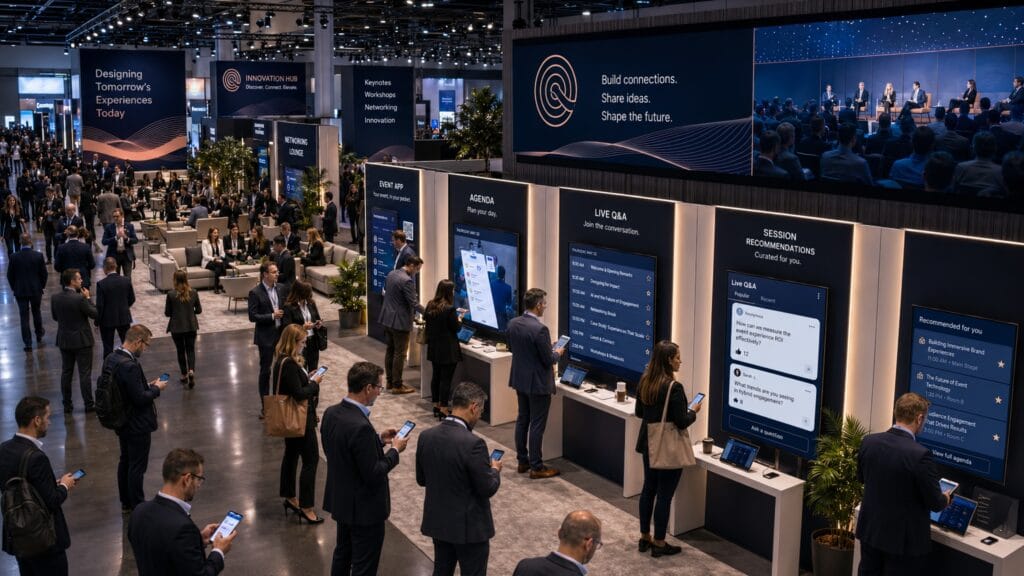
During an event, AI is most useful when it helps attendees navigate the experience with less friction. A busy conference program can be difficult to absorb, especially when multiple sessions, speakers, networking opportunities and sponsor activations compete for attention.
AI-supported tools can help attendees find sessions that match their interests, receive more relevant reminders, identify useful networking opportunities or access content summaries after a session. These details may seem small, but they can make the event feel easier to move through and more relevant to the individual.
There is also potential for AI to support live participation. Questions from the audience can be grouped by theme, polling results can be interpreted faster, and common discussion points can help moderators understand where attention is shifting. When used carefully, this can strengthen event engagement without distracting from the live experience.
The risk is over-automation. Attendees should not feel like they are being pushed through a system or reduced to data points. The best use of AI during an event is subtle, practical and useful. It should help people find more value in the room, not pull them away from it.
After the Event: Turning Data Into Better Follow-Up
After an event, AI can help organisers make sense of what happened more quickly. Survey comments, session attendance, audience questions, app activity, content downloads and follow-up enquiries can all reveal useful patterns, but they are often spread across different systems and reports.
AI can support this by grouping feedback themes, highlighting common concerns, identifying high-interest topics and showing where audience attention was strongest. This can help event teams move beyond a basic post-event report and understand what people actually responded to.
The follow-up experience can also become more relevant. Attendees who showed interest in a particular session may receive related content. Sponsors may receive clearer insight into audience behaviour. Speakers may understand which parts of their session generated the strongest response. Organisers may also identify where future content, networking or community activity could continue the conversation.
This is where post-event data connects naturally to event communities. When follow-up is based on what attendees cared about, rather than a generic thank-you email, it gives people a stronger reason to stay involved after the event ends.
Why Human Judgement Still Matters
AI can support planning, communication and reporting, but it cannot understand the full context of a live event on its own. It does not know the room, the relationships between stakeholders, the sensitivities behind certain topics or the tone an audience will respond to best.
That judgment still sits with people.
Event teams need to decide what should be automated, what should stay personal and where technology may create more distance than value. AI can assist a reminder email. A sensitive message to speakers, sponsors or key attendees may need a more careful human touch. Session recommendations can be useful, but they should not narrow the experience so much that attendees miss unexpected ideas or connections.
There are also questions around inclusion, accessibility and trust. If AI is used to personalise content, group attendees, or interpret feedback, organisers need to understand what data is being used and whether the outcome is fair, useful and appropriate.
The best event experiences are not built by choosing between technology and people. They come from knowing where each one belongs.
Designing Smarter Experiences, Not Just Faster Ones
The real value of AI in event work is not speed alone. Faster planning, faster reporting and faster communication can be useful, but only if they lead to a better experience for the people attending.
For conferences, summits and business events, AI is most valuable when it helps organisers understand what audiences need before the event, respond more clearly during the event and follow up with greater relevance afterwards. It can help reveal patterns, reduce friction and make the experience feel more considered.
What it should not do is flatten the human side of events. People still attend live experiences for ideas, connection, trust, conversation and moments that feel difficult to replicate elsewhere. Technology can support those outcomes, but it cannot create them without thoughtful design.
For the Future of Events Summit, this is where the conversation becomes most useful. The future of live experiences is not about adding technology because it is available. It is about using the right tools to create events that feel more relevant, more responsive and more human.
Frequently Asked Questions: AI in events and the event experience
Explore AI in events further at the Future of Events Summit, where event professionals, marketers and business leaders come together to examine what makes live experiences more meaningful, measurable and memorable. Book your ticket and continue the conversation.
- About the Author
- Latest Posts

Welcome to the official insights and editorial platform of the Future of Events Summit, a premium industry forum exploring the future of events, audience engagement, experience design and live brand experiences. Created by the team behind Pink Caviar Events, the platform shares industry perspectives, emerging trends, strategic conversations and practical insights for professionals working across events, marketing, communications and business experiences.